

Project Twitter
Part 1
Title
Pragmatic conditions of the interpretation of the tweets of Polish politicians
Research Material
Tweets of Polish politicians from a broad spectrum of political parties.
Aims
-
Identifying pragmatic functions: Information, Opinion, Attack, Self-Praise, Reader-Praise
-
Linguistic manifestation and the role of implicature and presupposition
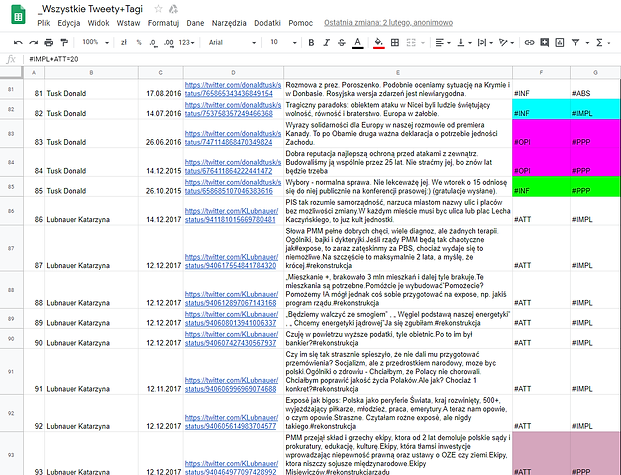
Image: An excerpt from the corpus prepared by the students.
(Click on the image to magnify)
Part 2 - Conference Presentation

Image: [From the left] Mateusz B. Wysocki, Katarzyna M. Koza, and Joanna K. Bojarska at YLMP Poznań 2018 (24.11.18)
(Click on the image to magnify)
Conference
Young Linguists’ Meeting in Poznań (YLMP) 2018, 23-25.11.18
Presentation
Are we on the same page? Linguistic manifestations of presupposition in political discourse on Twitter.
Authors: Joanna Katarzyna Bojarska, Katarzyna Magdalena Koza, Mateusz Bernard Wysocki
Abstract
The objective of this study is to provide a thorough analysis and compendious overview of the intricate issue of linguistic manifestations of presupposition in the political discourse of Polish politicians on Twitter. The choice of the topic has been motivated by the fact that scarcely has presupposition been an object of empirical research on social media, let alone examined in the environment in which each figure of speech carries as immense weight as in politics. The paper will elaborate on the way the implicit meaning is processed, what effects it has on the audience, and how it differs from the explicit meaning. Political discourse constitutes a perfect candidate for such an analysis, as the avoidance of taking the responsibility for one’s words causes politicians to use less straightforward means of communication. The reason for choosing Twitter is that the access to it is ubiquitous and many politicians use it as a medium of interaction with their colleagues as well as with the voters. Moreover, the character limit in tweets is of the utmost importance as it forces the author to express themselves in a very constrained string of text.
The research was based on the analysis of selected tweets written by the Polish politicians from the entire political spectrum, proving the universality of presupposition. The pragmatic functions of the implicit assumptions in the tweets had been assessed and tagged. The data was then taken under scrutiny to discover by what means presupposition is most often realised in a given environment. It occurred that it is most frequently manifested by the words carrying particular semantic associations which implicitly connote positive or negative images, as well as certain types of function words such as demonstratives and conjunctions. Sentence structure or stylistic variation appeared to be less often used as a carrier of implicit messages. The use thereof could create the assertion in the addressee that a statement is widely accepted and true, and therefore become convinced, which makes a strong proof that it can be a powerful tool in discourse, and hence, requires further meticulous investigation.
References:
Brown, G., & Yule, G. (1996). Discourse analysis. Cambridge: Cambridge University Press.
Griffiths, P. (2006). An introduction to English semantics and pragmatics. Edinburgh: Edinburgh University Press.
Kroeger, P. (2018). Analyzing meaning: An introduction to semantics and pragmatics. Berlin, Germany: Language Science Press.
Schwarz F. (2015) Experimental work in presupposition and presupposition projection. Annual review of linguistics, 2(1), 273-292. doi:10.1146/annurev-linguistics-011415-040809
Weller, K. (2014). Twitter and Society. New York: Peter Lang Publishing.